
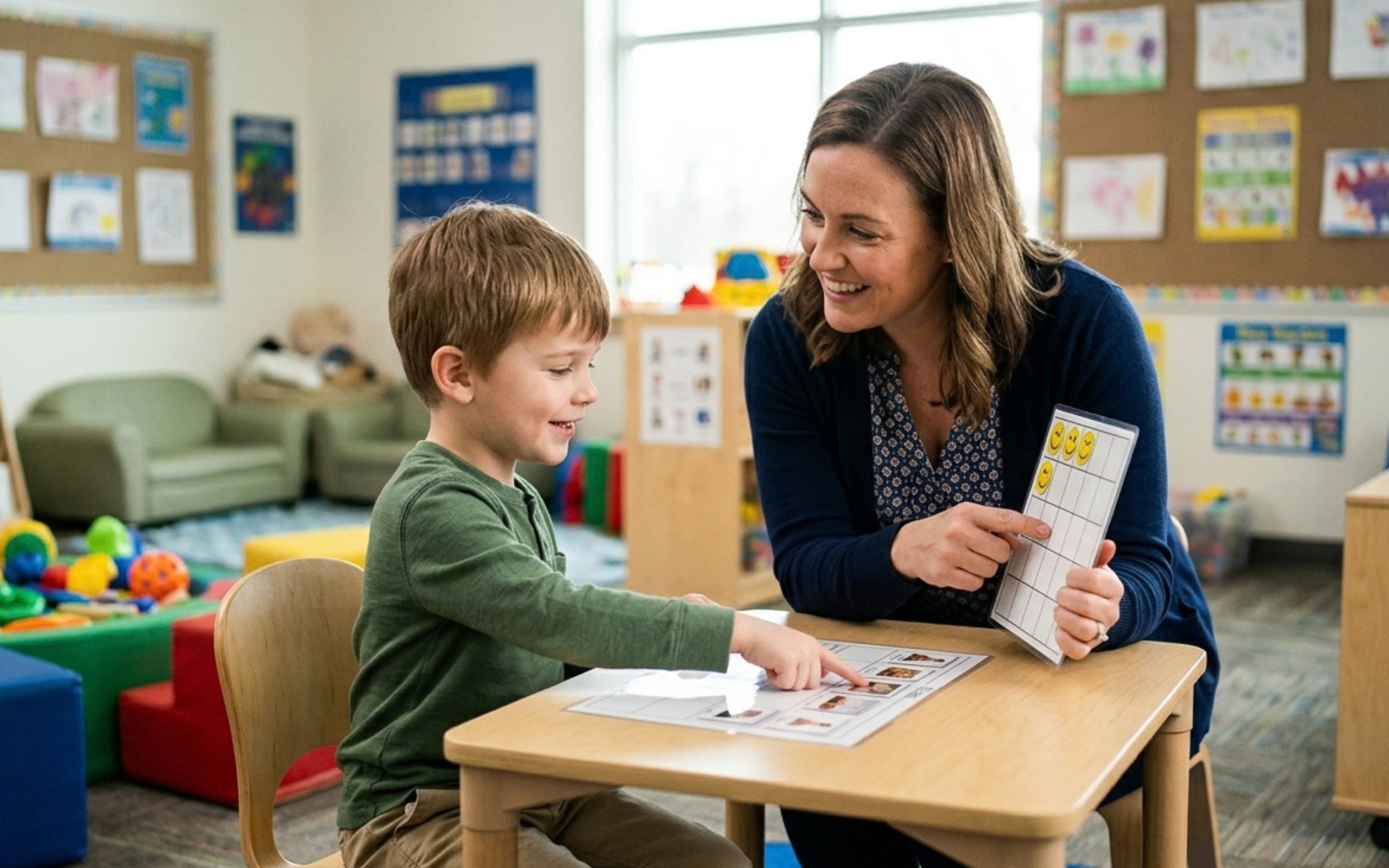
Creating a positive and supportive classroom environment can help children with autism feel more comfortable, engaged, and ready to learn. One evidence-based approach educators and caregivers can use is positive reinforcement. When used thoughtfully, positive reinforcement can encourage meaningful behaviors, build new skills, and help children experience greater success in the classroom.
Based on principles of applied behavior analysis (ABA), positive reinforcement focuses on recognizing and strengthening behaviors that support learning and participation. Rather than simply rewarding a child for completing an activity, effective reinforcement is individualized to the child’s interests, needs, and goals.
What Is Positive Reinforcement?
Positive reinforcement occurs when a meaningful consequence is provided after a desired behavior, making that behavior more likely to occur again in the future.
For example, if a student raises their hand to ask for help and the teacher immediately provides positive feedback and assistance, the student may become more likely to raise their hand when they need help in the future.
Reinforcement does not have to mean giving a tangible reward. Depending on the child, effective reinforcement might include:
- Specific verbal praise
- Extra time with a preferred activity
- Access to a favorite toy or classroom material
- A short movement break
- Stickers or tokens
- Choosing between two activities
- Positive attention from a teacher
- Opportunities to participate in a preferred classroom activity
The most important factor is that the reinforcement is meaningful to the individual child.
How ABA Strategies Can Support Classroom Learning
ABA therapy uses principles of learning and behavior to help individuals develop practical skills. Similar principles can be incorporated into classroom routines when appropriate and when they align with a student’s educational and behavioral goals.
Teachers and ABA professionals can work together to identify behaviors that support learning, such as:
- Following classroom directions
- Transitioning between activities
- Participating in group instruction
- Communicating needs appropriately
- Completing classroom assignments
- Waiting for a turn
- Staying engaged with an activity
- Asking for help
- Interacting appropriately with peers
The goal is not simply to make children comply with every classroom expectation. Instead, reinforcement can be used to teach functional skills that increase independence, communication, participation, and access to learning.
Identify What Motivates the Child
Every child is different. Something that motivates one student may not be meaningful to another.
Teachers can observe what a child naturally enjoys and incorporate those interests into reinforcement opportunities. Preferences may include:
- Drawing or coloring
- Books
- Music
- Sensory activities
- Building materials
- Favorite characters
- Movement activities
- Technology
- Time with a preferred toy
Preferences can also change throughout the day, so educators should continue observing what works for each student.
Use Specific Praise
Instead of simply saying “Good job,” provide feedback that tells the child exactly what they did successfully.
For example:
“Great job putting your materials away when the timer went off!”
Or:
“You asked for help using your words. Nice communicating!”
Specific praise helps children understand which behavior is being recognized, making it easier to repeat that behavior in the future.
Reinforce Small Steps
Some classroom tasks may feel overwhelming when they involve multiple steps. Breaking an activity into smaller, achievable parts can help a child experience success.
For example, instead of expecting a student to immediately complete an entire worksheet, an educator might reinforce smaller steps such as:
- Getting the worksheet.
- Sitting at the work area.
- Completing the first problem.
- Completing several problems.
- Finishing the assignment.
As the child becomes more successful, reinforcement can gradually shift toward greater independence and completion of larger portions of the task.
Pair Reinforcement With Communication
Positive reinforcement can also encourage functional communication.
For example, a student who wants a break might be taught to say “break,” use a picture card, gesture, or use an AAC device. When the child appropriately communicates the need, the request can be acknowledged.
This approach can help children learn that effective communication is a useful way to express wants and needs.
For children receiving ABA services, communication goals can be individualized and coordinated with classroom expectations so that skills learned in one setting can be practiced in another.
Use Visual Supports
Visual schedules, first-then boards, token systems, and visual reminders can make classroom expectations more predictable.
A simple “First-Then” strategy might look like:
First: Complete three math problems
Then: Choose a preferred activity
Visual supports can be particularly helpful when a child has difficulty understanding verbal directions or anticipating changes in routine.
Reinforce Appropriate Alternatives
When a child engages in a challenging behavior, educators can focus on teaching and reinforcing an appropriate way to accomplish the same goal whenever possible.
For example, if a student frequently leaves their seat because they need a break, the team might teach the student to appropriately request a break. When the student uses the new communication skill, it can be reinforced.
This type of autism behavior support emphasizes teaching useful replacement skills rather than focusing only on reducing challenging behavior.
Be Consistent Across Adults and Settings
Consistency can make reinforcement easier for children to understand.
Teachers, classroom aides, caregivers, and ABA professionals can communicate about:
- Which skills are being targeted
- What reinforcement is meaningful
- How reinforcement will be delivered
- What prompts or visual supports are being used
- How progress will be monitored
Consistency does not mean every adult must respond in exactly the same way. Instead, shared expectations and communication can help children practice skills across different environments.
Benefits of Positive Reinforcement in the Classroom
When thoughtfully individualized, posit1`ive reinforcement may provide several benefits for children with autism, including:
Increased Engagement
Recognizing and reinforcing participation can help make learning activities more motivating and encourage children to remain engaged.
Development of New Skills
Reinforcement can support the acquisition of academic, communication, social, self-help, and classroom skills.
Greater Independence
As children learn which behaviors help them access preferred activities, assistance can gradually be reduced and independence can increase.
Improved Communication
Reinforcing functional communication can help children learn effective ways to express requests, preferences, questions, and needs.
More Positive Learning Experiences
A classroom that recognizes effort and progress can help create opportunities for children to experience success rather than focusing exclusively on mistakes or challenging behavior.
Generalization of Skills
Coordinating ABA therapy, classroom instruction, and home routines can provide children with opportunities to practice skills in different environments and with different people.
Making Reinforcement Individualized
Effective reinforcement should never be a one-size-fits-all strategy. Educators and professionals should consider the child’s developmental level, communication style, preferences, sensory needs, learning goals, and classroom environment.
It is also important to regularly evaluate whether a strategy is working. If a child is not responding to a particular reinforcer, the team may need to explore other preferences or adjust the teaching approach.
For children receiving ABA services, a Board Certified Behavior Analyst (BCBA) or other qualified professional can help develop individualized strategies and coordinate them with educational goals when appropriate.
Supporting Children Through Positive Reinforcement
Positive reinforcement is one tool that can help create a more supportive learning environment for children with autism. Through applied behavior analysis, educators and ABA professionals can use individualized reinforcement strategies to encourage communication, participation, independence, and skill development.
The most effective approach focuses on understanding why a behavior is occurring, teaching meaningful skills, and recognizing progress. When teachers, caregivers, and professionals work together, children can have more opportunities to practice skills and experience success both inside and outside the classroom.
Final Thoughts
Positive reinforcement is about more than rewards. It is about recognizing meaningful progress and creating learning experiences that encourage children to continue developing useful skills.
With thoughtful autism behavior support, individualized ABA therapy, and collaboration between educators, caregivers, and ABA professionals, reinforcement strategies can become a valuable part of a child’s educational experience.