
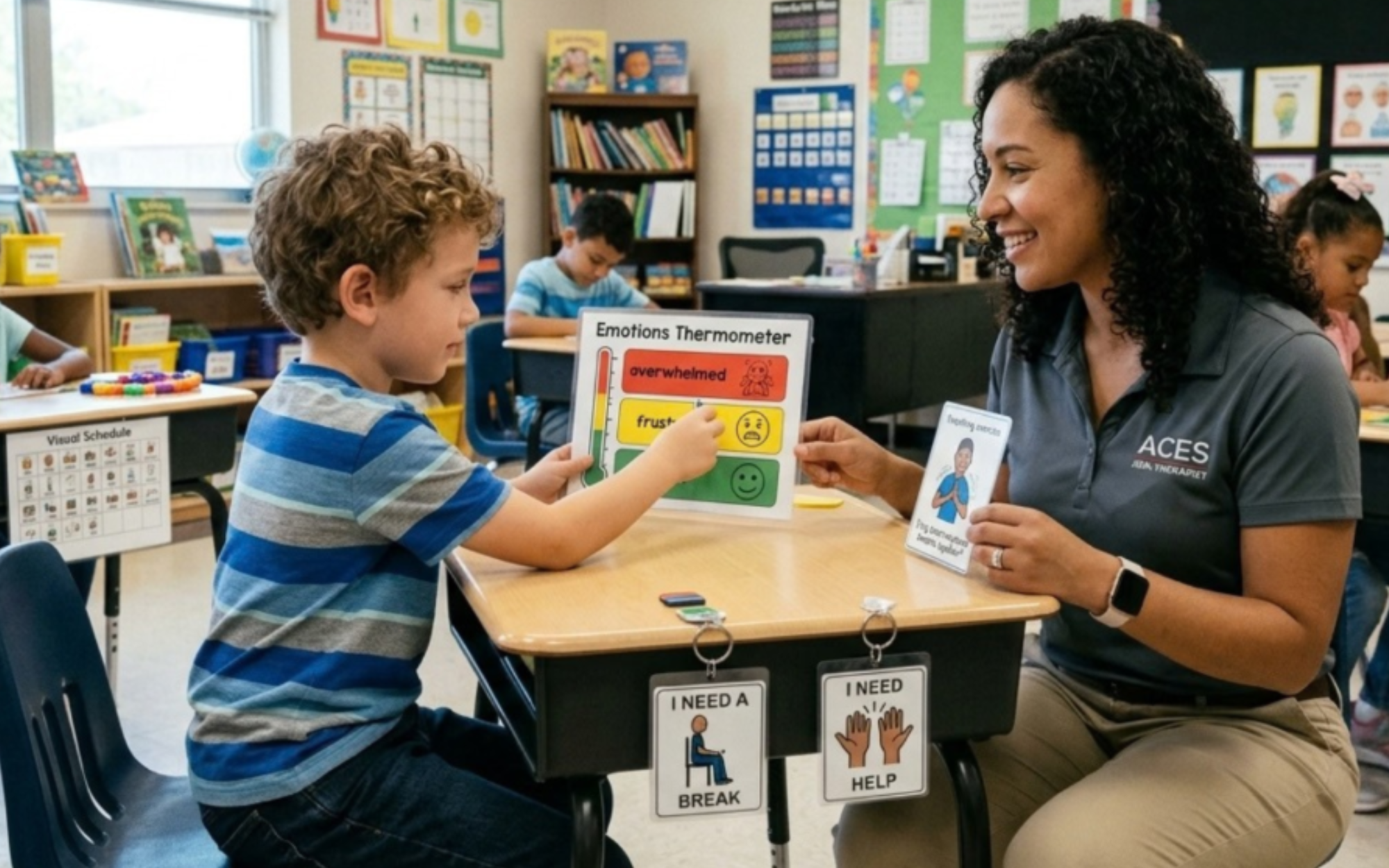
The classroom can be an exciting place for children to learn, socialize, and explore new ideas, but it can also present challenges for children who have difficulty managing their emotions. For children with autism, changes in routine, sensory distractions, academic demands, social interactions, and unexpected situations may sometimes lead to frustration or emotional overwhelm.
Developing emotional regulation skills can help children recognize their emotions, communicate their needs, and learn appropriate strategies for managing challenging situations. ABA therapy, based on the principles of applied behavior analysis, can provide individualized strategies to help children build these important skills and participate more successfully in the classroom.
What Is Emotional Regulation?
Emotional regulation refers to the ability to recognize, understand, and manage emotional responses in ways that support participation in everyday activities. For a child, this might include:
- Identifying emotions such as happy, sad, frustrated, or angry
- Communicating when they need help or a break
- Coping with changes in routines
- Waiting for a preferred activity
- Managing frustration when something does not go as expected
- Using calming strategies
- Returning to an activity after becoming upset
- Appropriately expressing wants, needs, and feelings
These skills can look different for every child. Effective autism behavior support focuses on understanding the individual child’s needs rather than expecting every child to respond to emotions in the same way.
How ABA Can Support Emotional Regulation
ABA services can help identify situations that may make emotional regulation more difficult and teach practical replacement skills. Through individualized goals, reinforcement, modeling, prompting, and practice, children can learn strategies that can be used across classroom routines.
Teaching Children to Identify Their Emotions
Before children can learn how to manage an emotion, they may need support recognizing what they are experiencing.
ABA therapy can incorporate activities that help children identify emotions using pictures, stories, role-playing, facial expressions, or real-life classroom situations. A child might learn to distinguish between feeling frustrated, worried, excited, or calm.
Over time, recognizing these emotions can help children communicate how they are feeling before the situation becomes overwhelming.
Building Functional Communication Skills
Sometimes challenging behavior occurs because a child does not yet have an effective way to communicate what they need.
Applied behavior analysis can support functional communication by teaching children appropriate ways to express requests such as:
- “I need help.”
- “Can I have a break?”
- “I’m finished.”
- “That’s too loud.”
- “I don’t understand.”
- “Can I have more time?”
Providing children with effective communication tools can reduce frustration and give them greater control over how they express their needs.
Teaching Coping and Calming Strategies
Children can learn strategies for managing strong emotions, but these strategies often need to be explicitly taught and practiced.
Depending on the child’s needs, an ABA provider may help teach skills such as:
- Taking deep breaths
- Asking for a break
- Using a quiet area
- Counting or engaging in another calming activity
- Using visual supports
- Asking for assistance
- Following a calming routine
- Returning to the classroom activity when ready
The goal is to help children develop practical skills they can use when they encounter challenging situations.
Using Positive Reinforcement
Positive reinforcement is an important component of many ABA programs. When a child uses an appropriate emotional regulation or communication skill, reinforcement can encourage that behavior to occur again.
For example, if a child appropriately asks for help instead of becoming frustrated during a difficult assignment, a teacher or ABA professional can provide positive feedback and the appropriate support.
Over time, consistent reinforcement can help strengthen useful skills and encourage children to use them more independently.
Practicing Skills During Everyday Classroom Activities
Emotional regulation skills are most useful when children can apply them in real-world situations. ABA services can incorporate opportunities to practice these skills during classroom routines rather than only during structured teaching activities.
For example, a child might practice:
- Waiting during transitions
- Asking for help with an assignment
- Handling an unexpected change
- Sharing materials with classmates
- Participating in group activities
- Taking a break appropriately
- Returning to work after a break
Practicing skills in natural environments can help children understand when and how to use them throughout the school day.
Benefits of Supporting Emotional Regulation Through ABA
Individualized emotional regulation support can provide several potential benefits for children with autism, including:
Improved Communication
Children may learn more appropriate and effective ways to communicate their emotions, wants, and needs.
Increased Independence
As children learn to recognize emotions and choose appropriate coping strategies, they may become less dependent on adults to help them navigate challenging situations.
Greater Classroom Participation
When children have strategies for managing frustration or sensory challenges, they may be better able to participate in academic, social, and group activities.
Reduced Frustration
Teaching functional communication and coping skills can give children alternatives to behaviors that may occur when they feel overwhelmed or unable to communicate.
Stronger Social Skills
Emotional regulation can support positive interactions with teachers and peers by helping children navigate waiting, sharing, turn-taking, conflict, and other social situations.
Improved Confidence
Learning that they have tools to handle challenging situations can help children feel more capable and successful in the classroom.
The Importance of Individualized Autism Behavior Support
Every child with autism has different strengths, needs, preferences, and communication styles. For this reason, emotional regulation strategies should be individualized.
A child’s ABA team can work with caregivers, teachers, and other professionals to identify situations that may be challenging and develop strategies that support the child’s specific goals. Collaboration can also help ensure that skills learned during ABA therapy are reinforced consistently across environments.
Importantly, emotional regulation support should focus on helping children communicate, cope, participate, and feel supported—not simply on making emotional expressions disappear. Understanding what a child is communicating through their behavior can help adults respond with appropriate support.
Supporting Emotional Regulation Beyond the Classroom
The skills children learn through ABA can extend beyond the school environment. When caregivers and educators use consistent strategies, children have more opportunities to practice emotional regulation across different settings.
For example, a child who learns to say “I need a break” at school may eventually use that same communication skill at home, in the community, or during other activities. This type of skill generalization can make emotional regulation strategies more useful in everyday life.
Helping Children Build Skills for Success
Emotional regulation is an important part of learning and participating in the classroom. For children with autism, individualized ABA services can provide structured opportunities to develop communication, coping, flexibility, and self-management skills.
Through applied behavior analysis, children can practice recognizing emotions, communicating their needs, using coping strategies, and navigating challenging classroom situations. With collaboration between ABA professionals, educators, and families, autism behavior support can help create an environment where children have the tools they need to learn, connect, and participate more comfortably.
Ultimately, the goal of ABA therapy is to support meaningful, functional skills that can help children become more independent and confident across their daily lives.