
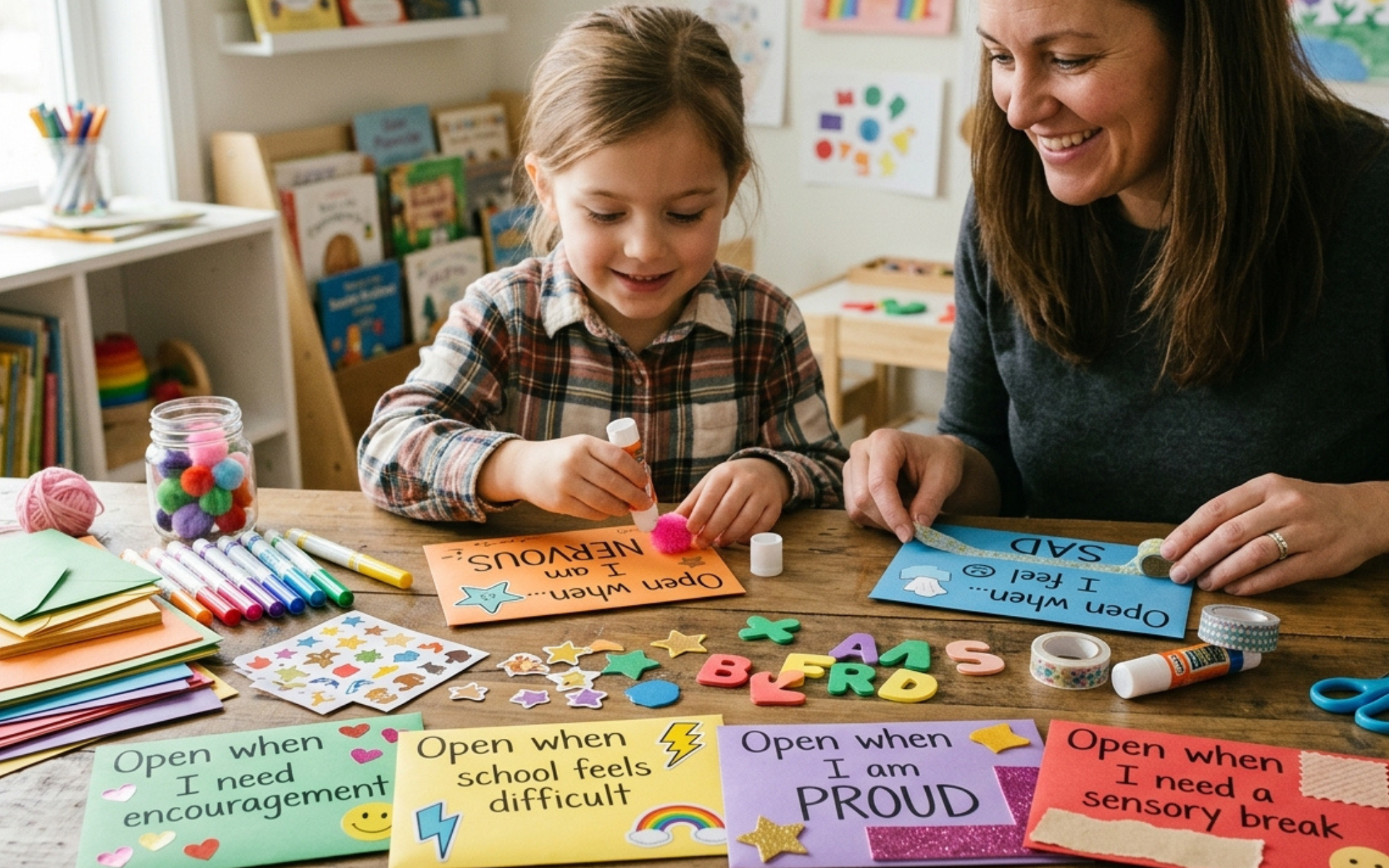
Back-to-school season is a great time to help children build confidence, recognize emotions, and create simple tools they can use when they need encouragement. “Open When…” encouragement envelopes are an easy, customizable sensory craft that can be adapted for different ages, interests, and sensory preferences.
This activity can be especially useful for children with autism, as well as children who benefit from structured opportunities to identify emotions and practice coping strategies. When incorporated appropriately into ABA therapy, classroom activities, or ABA services, the craft can become more than just a creative project—it can provide a visual and hands-on way to support communication and emotional regulation.
What Are “Open When…” Encouragement Envelopes?
The idea is simple: create several decorated envelopes with messages such as:
- Open when you feel sad.
- Open when you need a break.
- Open when you’re feeling nervous.
- Open when you need encouragement.
- Open when you feel proud of yourself.
- Open when you need a reminder that you can do it.
- Open when school feels difficult.
Inside each envelope, children can place a small note, picture, activity, sensory item, or coping strategy.
For children who prefer visual communication, the envelopes can also include pictures, symbols, or simple words rather than relying entirely on written instructions.
How to Make the Sensory Craft
Materials
You can keep this craft inexpensive and simple:
- Small envelopes
- Construction paper or cardstock
- Stickers
- Washable markers or crayons
- Glue
- Yarn, ribbon, or textured paper
- Pom-poms
- Foam shapes
- Washi tape
- Small pieces of paper for encouragement notes
- Optional sensory materials appropriate for the child
Step 1: Choose the “Open When…” Messages
Start with a few situations that are meaningful to the child. Instead of making too many envelopes, begin with three to five.
For example:
Open when I feel nervous
Inside: A short breathing exercise or calming picture.
Open when I need encouragement
Inside: A positive note such as, “You are doing your best!”
Open when I need a sensory break
Inside: A reminder to ask for a break or use an approved calming activity.
Open when I am proud
Inside: A blank card where the child can draw or write something they accomplished.
Step 2: Make It Sensory-Friendly
This is where the craft becomes a sensory activity.
Invite the child to choose materials based on their preferences. Some children may enjoy the soft texture of pom-poms, while others may prefer smooth stickers, shiny paper, or textured foam.
Remember that sensory preferences vary widely, particularly among autistic children. Never assume that a particular texture will be calming or enjoyable. Give the child choices and allow them to skip materials they dislike.
You can also make the activity more accessible by offering:
- Large, easy-to-grip stickers
- Pre-cut shapes
- Thick markers
- Glue sticks instead of liquid glue
- Visual examples
- A quieter workspace
- The option to participate without touching certain textures
Step 3: Add Encouraging Messages
Once the envelopes are decorated, create the notes that will go inside.
Keep messages short and positive. Depending on the child’s communication and reading abilities, these can be written, drawn, printed, or represented with pictures.
Examples include:
“Take three slow breaths.”
“You can ask for help.”
“It’s okay to take a break.”
“You worked hard today.”
“You are safe and supported.”
“One step at a time.”
The goal isn’t to force a child to use a particular coping strategy. Instead, the envelopes can provide choices and reminders that the child can access when appropriate.
Benefits of “Open When…” Encouragement Envelopes
1. Encourages Emotional Awareness
Creating different envelopes gives children opportunities to think about emotions and situations. They can practice identifying how they feel and connecting feelings with appropriate forms of support.
2. Supports Communication
The envelopes can provide a visual way for children to communicate what they need.
For example, a child who has difficulty verbally saying, “I need a break,” might point to an envelope labeled “Open When I Need a Break.”
For children receiving autism behavior support, individualized visual supports can be incorporated into broader communication and behavior-support strategies when recommended by their care team.
3. Provides Hands-On Sensory Experiences
Cutting, coloring, sticking, folding, and decorating provide opportunities for hands-on exploration. The activity can incorporate different textures while allowing children to maintain control over what they touch.
4. Builds Independence
Children can learn to recognize when they need encouragement or support and then access a predetermined resource.
This can complement goals addressed in ABA therapy, particularly when the activity is individualized and used as part of a broader plan developed by qualified professionals.
5. Encourages Self-Advocacy
Messages such as “I can ask for help” or “I can ask for a break” can reinforce the idea that children have appropriate ways to communicate their needs.
6. Builds Confidence
A collection of positive notes can give children reminders of their strengths, accomplishments, and progress. This can be especially helpful during the transition back to school.
7. Creates a Predictable Routine
Children often benefit from knowing what to expect. A consistent system of labeled envelopes can provide a simple visual routine for accessing different types of encouragement.
Using the Craft With ABA Services
For families participating in ABA services, this craft can be adapted to complement individualized goals. For example, a qualified ABA professional might help a child practice identifying emotions, requesting a break, following a visual sequence, making choices, or communicating a need.
The important part is individualization. A strategy that works well for one child may not work for another. The envelopes should support the child’s existing communication style, sensory preferences, and goals rather than requiring the child to interact with materials in a specific way.
For this reason, parents, teachers, and professionals providing ABA therapy or other autism supports can collaborate to determine how the craft might fit into the child’s existing routines.
Make It a Back-to-School Tradition
The best part about “Open When…” envelopes is that they can grow with your child. At the beginning of the school year, create a small collection together. Throughout the year, add new envelopes based on experiences and accomplishments.
You might eventually add:
- Open when I have a great day.
- Open when I make a new friend.
- Open when I accomplish a goal.
- Open when I need to remember something I’ve learned.
- Open when I need a little extra confidence.
Whether you’re a parent, teacher, therapist, or caregiver, this simple craft offers an opportunity to combine creativity, sensory exploration, emotional learning, and communication support in one activity.
Most importantly, let the child take the lead. The goal isn’t to create perfect envelopes—it’s to create a supportive tool that feels meaningful, comfortable, and useful to them.